
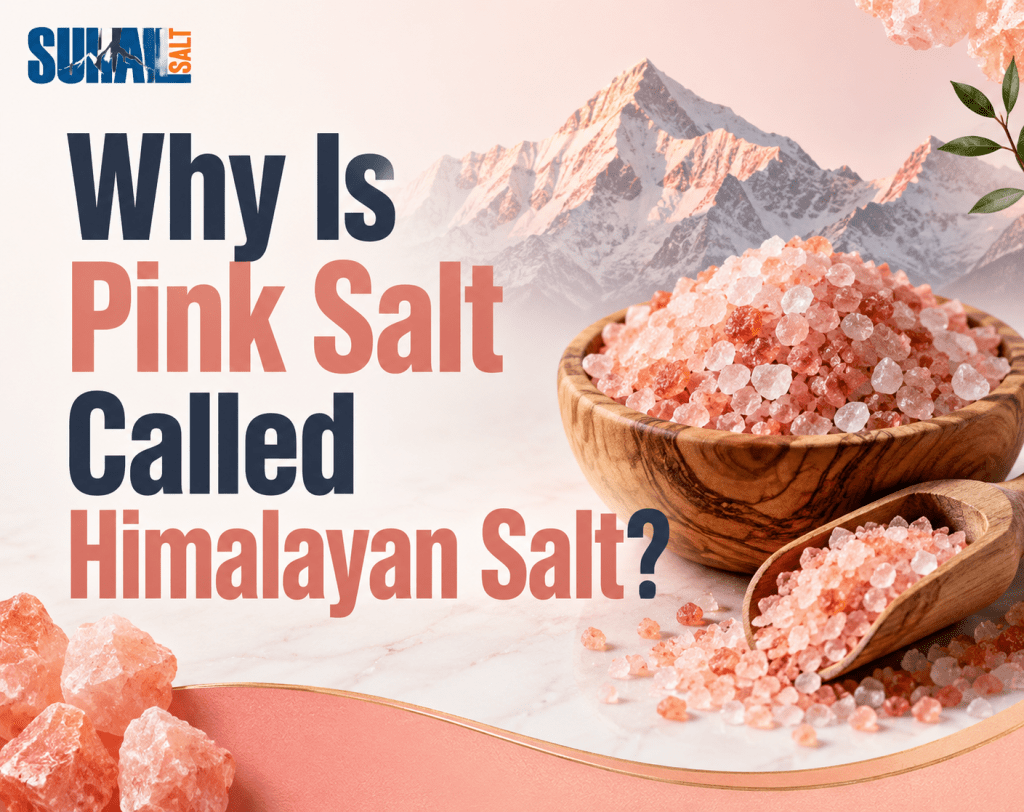
If you have ever spotted a jar of rosy-pink crystals on a grocery shelf or a glowing pink lamp in a wellness store, you have seen Himalayan salt in action. But why exactly is pink salt called Himalayan salt? The name raises a genuine question — especially since the famous Khewra Salt Mine, which produces the vast majority of this mineral, sits in Pakistan’s Punjab province, not directly in the Himalayan mountain range.
The answer lies in geology, geography, and ancient history — all converging in one of the most mineral-rich salt deposits on Earth. In this article, we explore the origin of the name Himalayan salt, unpack the science behind its pink hue, explain its 84+ trace minerals, and clarify why Suhail Salt — Pakistan’s trusted Himalayan salt manufacturer and exporter — is your most reliable wholesale source.
|
Source Premium Himalayan Salt Directly From Pakistan Suhail Salt supplies bulk Himalayan salt to importers, retailers, and distributors worldwide. [ Request a Free Wholesale Quote → suhailsalt.com ] |
The Geographic Origin: Why ‘Himalayan’?
The term Himalayan salt refers to rock salt extracted from the Salt Range — a chain of hills in Punjab, Pakistan, that runs parallel to the Himalayan foothills in the north. Geographically, the Salt Range lies approximately 200 to 300 kilometers from the Himalayan peaks.
However, the geological connection is direct and undeniable. The Salt Range formed as part of the same tectonic activity that uplifted the Himalayas. When the ancient Tethys Sea evaporated hundreds of millions of years ago, it left enormous salt deposits. The same seismic forces that pushed the Himalayas skyward also folded, compressed, and preserved these sea-bed salt layers underground.
The Khewra Salt Mine — the world’s second-largest salt mine and the primary source of Himalayan salt — sits within this Salt Range. So while the mine is not literally inside the Himalayan peaks, it owes its very existence to Himalayan geological forces. Calling this salt ‘Himalayan’ is both historically accurate and geologically justified.
The Khewra Salt Mine: Heart of Himalayan Salt Production
Discovered in the 13th century by Alexander the Great’s cavalry horses licking the rocks, the Khewra Salt Mine has been commercially mined since the Mughal era. Today, it is a UNESCO-recognized landmark and a major tourist attraction in Pakistan, featuring illuminated salt chambers, a mosque built of salt bricks, and a replica of the Great Wall of China — all carved from living pink salt.
The mine stretches across 17 stories, with 19 working mines and over 40 kilometers of tunnels. Miners extract an estimated 350,000 metric tons of salt annually, supplying both domestic consumption and international wholesale markets. Suhail Salt sources directly from this mine, ensuring authenticity, purity, and traceability for every wholesale order.
What Makes Himalayan Salt Pink? The Mineral Science
The iconic pink color of Himalayan salt is not artificial. No dye, no treatment, no additive is involved. The rosy to deep red hue comes from iron oxide — the same compound that gives rust its orange-red color — combined with a rich profile of over 84 trace minerals locked into the salt crystal structure.
These minerals include magnesium, potassium, calcium, zinc, copper, selenium, and iodine, among others. Their varying concentrations produce a spectrum of colors in Himalayan salt crystals, ranging from translucent white and pale pink to deep rose and even reddish-brown. Darker crystals carry a higher iron oxide concentration, while lighter crystals are purer in sodium chloride content.
84+ Trace Minerals: What They Mean for Quality
Standard table salt is almost entirely sodium chloride (99%+), stripped of trace minerals through heavy industrial processing and bleaching. In contrast, Himalayan salt preserves its naturally occurring mineral matrix. This mineral diversity is a key selling point for health-conscious consumers and a distinguishing quality marker for wholesale buyers.
For B2B buyers sourcing bulk Himalayan salt for food processing, nutraceutical packaging, spa products, or private-label retail, the mineral spectrum matters. It drives consumer preference, justifies premium pricing, and supports product claims in health and wellness markets across Europe, North America, and Australia.
|
Need a Mineral Analysis Certificate? Suhail Salt provides lab-tested mineral reports and FDA/SGS-compliant documentation for every wholesale shipment. [ Contact Our Export Team → suhailsalt.com/contact ] |
Himalayan Salt vs. Regular Table Salt: A Clear Comparison
| Property | Himalayan Salt | Table Salt |
| Origin | Khewra Mine, Pakistan (natural) | Industrial processing (refined) |
| Color | Pink to deep rose | Bright white (bleached) |
| Minerals | 84+ trace minerals | Sodium chloride only |
| Processing | Hand-mined, minimal | Heavy chemical processing |
| Flavor | Mild, earthy, complex | Sharp, flat, artificial |
| Uses | Cooking, lamps, spa, livestock | Cooking, industrial use |
| Sodium Content | ~98% NaCl | ~99.9% NaCl |
| Market Demand | Premium, fast-growing | Commodity |
The History of Himalayan Salt: 250 Million Years in the Making
Himalayan salt is not a modern discovery. Its story begins around 250 to 300 million years ago, during the Precambrian era, when a vast inland sea — the ancient Tethys Ocean — covered what is now South Asia. As the climate shifted and the sea evaporated over millions of years, it left behind massive beds of pure crystalline salt.
These deposits became buried under layers of rock and sediment as tectonic plates collided, pushing up the Himalayan mountain range. The immense pressure, heat, and geological isolation preserved the salt in a near-pristine state — free from modern pollutants, microplastics, and industrial contamination.
This ancient purity is a major marketing advantage in global wholesale markets. Unlike sea salt harvested from today’s oceans — which may carry microplastics and pollution — Himalayan salt predates any human industrial activity by hundreds of millions of years.
|
Ancient Purity. Modern Packaging. Global Delivery. Suhail Salt ships Himalayan salt in bulk and retail-ready packaging to 30+ countries. [ Explore Our Export Catalog → suhailsalt.com/products ] |
Why Pakistan — Not India — Is the True Source of Himalayan Salt
A common misconception in global markets is that Himalayan salt originates from the Indian subcontinent or the Indian side of the Himalayas. In fact, commercial Himalayan salt supply — virtually 100% of it — comes from Pakistan, specifically from the Khewra Salt Mine in Punjab.
Pakistan controls the Salt Range entirely. While the word ‘Himalayan’ carries strong geographic brand recognition, it is important for importers, distributors, and retailers to understand that authentic Himalayan salt originates from Pakistani mines, processed and exported by Pakistani manufacturers like Suhail Salt.
This is especially relevant for compliance-conscious buyers in Europe, the US, Australia, and the Middle East who need to declare the country of origin accurately on product labels. Working directly with a Pakistani Himalayan salt manufacturer like Suhail Salt ensures proper documentation, certificates of origin, and regulatory compliance.
Suhail Salt: Pakistan’s Trusted Himalayan Salt Exporter
Suhail Salt is a vertically integrated Himalayan salt manufacturer and exporter based in Pakistan. With direct sourcing from the Khewra Salt Mine and full-facility processing, Suhail Salt offers wholesale buyers a transparent supply chain — from mining to final packaging.
Our product range includes edible Himalayan salt (fine, coarse, and extra-coarse grinds), Himalayan salt lamps, salt tiles, animal lick blocks, bath salts, and custom private-label options. We serve importers, food brands, wellness retailers, and spa businesses in Europe, North America, Asia-Pacific, and the Middle East.
Uses of Himalayan Salt: Beyond the Kitchen
Himalayan salt has transcended its role as a simple cooking ingredient. Today, it serves a remarkably diverse range of applications across food, wellness, agriculture, and décor — driving its rapid growth as a global commodity.
1. Culinary Use
Himalayan salt performs excellently as a finishing salt, a seasoning agent, and even as a cooking surface. Salt slabs and blocks, when heated, can be used as griddles for meats and vegetables, imparting a subtle mineral flavor. Fine-ground Himalayan salt is ideal for baking and everyday cooking, while coarse crystals suit marinades, pickling, and garnishing.
2. Salt Lamps and Air Purification
Himalayan salt lamps are carved from large pink salt crystals and fitted with a heat bulb inside. The warm glow creates a calming ambiance and, according to proponents, may release negative ions that contribute to air quality improvement. While scientific evidence remains mixed, salt lamps enjoy massive consumer demand in wellness markets globally.
3. Bath and Skincare Products
Himalayan bath salts dissolve in warm water to create a mineral-rich soak believed to support skin hydration, muscle relaxation, and detoxification. Cosmetic brands incorporate Himalayan salt into scrubs, masks, and spa treatments, making it a valuable ingredient in the personal care industry.
4. Animal Nutrition: Salt Lick Blocks
Himalayan pink salt lick blocks are widely used in agriculture and equestrian settings. Animals naturally crave essential minerals, and Himalayan salt lick blocks provide sodium, magnesium, potassium, and iron in a convenient, long-lasting form. These blocks are a major export category for Suhail Salt, supplying livestock farms and pet retailers worldwide.
|
Looking for Bulk Himalayan Salt Lick Blocks? Suhail Salt supplies animal lick blocks in 2kg, 5kg, and custom sizes for retail and farm use. [ Get Wholesale Pricing → suhailsalt.com/lick-blocks ] |
Himalayan Salt in Global Trade: Market Trends and Wholesale Demand
The global Himalayan salt market has grown significantly over the past decade. Rising consumer awareness about natural food ingredients, clean-label products, and mineral nutrition has driven demand across food retail, wellness, and e-commerce channels.
Key importing regions include the United States, Germany, the United Kingdom, Australia, Canada, and the UAE. For wholesale buyers, sourcing directly from a Pakistani Himalayan salt manufacturer — rather than through intermediaries — delivers significant cost advantages, faster lead times, and full supply chain transparency.
Suhail Salt works with container-load buyers and pallet-level importers alike. Our export documentation includes certificates of origin, halal certification, lab analysis reports, and SGS/food-grade safety compliance — meeting import requirements across all major markets.
Why Buy Himalayan Salt Wholesale from Suhail Salt?
• Direct mine-to-market supply chain — no middlemen
• Competitive FOB and CIF pricing for all order volumes
• Full regulatory documentation: COO, halal, lab reports
• Custom retail packaging for private label brands
• Consistent quality control across every shipment
• Dedicated export team with global logistics expertise
Authority References
The following external sources provide scientific, geographic, and nutritional context supporting the information in this article:
• USDA FoodData Central — Mineral composition of salt varieties (fdc.nal.usda.gov)
• Geological Survey of Pakistan — Salt Range formation and Khewra Mine data (gsp.gov.pk)
• PubMed / National Library of Medicine — Studies on dietary minerals and sodium intake (pubmed.ncbi.nlm.nih.gov)
• UNESCO — Khewra Salt Mine cultural heritage documentation (whc.unesco.org)
• Healthline — Himalayan salt health benefits review (healthline.com/nutrition/pink-himalayan-salt)
People Also Ask: Himalayan Salt Questions Answered
Below are the most frequently searched questions about Himalayan salt, organized from highest to lowest search demand, with concise answers:
| People Also Ask | Answer |
What is Himalayan salt? |
Himalayan salt is a natural rock salt mined from the Khewra Salt Mine in Pakistan. It is rich in over 84 trace minerals and is recognized by its distinctive pink color. |
Why is pink salt called Himalayan salt? |
Pink salt is called Himalayan salt because it is mined from the Salt Range mountains near the Himalayas in Pakistan. Its proximity to the Himalayan foothills and its ancient oceanic origin give it this iconic name. |
Is Himalayan salt healthier than regular salt? |
Himalayan salt contains trace minerals absent in regular table salt. However, its sodium content is similar, so it should be consumed in moderation just like any salt. |
Where does Himalayan salt come from? |
Himalayan salt comes primarily from the Khewra Salt Mine in Punjab, Pakistan — one of the world’s largest and oldest salt mines, located in the Salt Range near the Himalayan foothills. |
What gives Himalayan salt its pink color? |
The pink color of Himalayan salt comes from trace amounts of iron oxide (rust) and other minerals like magnesium, calcium, and potassium present within the ancient rock salt deposits. |
Is Himalayan salt the same as pink salt? |
Yes, Himalayan salt and pink salt are often used interchangeably. Pink salt specifically refers to the rosy hue caused by iron oxide, while Himalayan refers to its geographic origin near the Himalayas. |
Can you use Himalayan salt for cooking? |
Absolutely. Himalayan salt is widely used for cooking, grilling, baking, and seasoning. Its mild flavor and mineral content make it a popular alternative to refined table salt. |
How old is Himalayan salt? |
Himalayan salt is estimated to be around 250 to 300 million years old, formed from ancient sea beds that were compressed under the earth during the formation of the Himalayan mountain range. |
Does Himalayan salt have any health benefits? |
Himalayan salt provides essential electrolytes and trace minerals. It may support hydration, digestion, and pH balance, though scientific evidence for dramatic health claims remains limited. |
What are the uses of Himalayan salt? |
Himalayan salt is used in cooking, salt lamps, bath salts, skincare products, spa treatments, animal lick blocks, and food preservation — making it one of the most versatile natural minerals. |
| Is Himalayan salt from Pakistan or India? | Himalayan salt is primarily sourced from Pakistan, specifically from the Khewra Salt Mine in Punjab. While the Himalayas span multiple countries, the commercial Himalayan salt supply originates from Pakistan. |
What minerals are in Himalayan salt? |
Himalayan salt contains over 84 trace minerals, including sodium chloride, potassium, calcium, magnesium, iron, zinc, iodine, copper, and selenium, giving it its unique color and flavor profile. |
Is Himalayan salt good for high blood pressure? |
Himalayan salt still contains sodium, which can raise blood pressure if consumed in excess. It is not medically recommended as a treatment for hypertension. Always consult a doctor for dietary advice. |
How is Himalayan salt mined? |
Himalayan salt is hand-mined from deep underground tunnels at Khewra using traditional methods. Miners extract large salt blocks that are then processed, graded, and packaged for domestic and export markets. |
Why is Himalayan salt so expensive? |
Himalayan salt commands a premium price due to its artisanal hand-mining process, long supply chain from remote Pakistani mines, high demand in health and wellness markets, and its perceived mineral richness. |
Conclusion: The Name Says It All
Himalayan salt earns its iconic name from its ancient origins — formed from the evaporated Tethys Sea and preserved through the same tectonic forces that built the Himalayan mountain range. The pink color comes from natural iron oxide and over 84 trace minerals, making it visually distinctive and commercially appealing across food, wellness, and agricultural markets.
For wholesale buyers, importers, and private-label brands looking to source authentic Himalayan salt with verified quality, Suhail Salt offers a direct, transparent, and compliant supply chain from Pakistan’s Khewra Salt Mine to your facility, wherever in the world you operate.
|
Ready to Source Himalayan Salt at Wholesale Prices? Join hundreds of importers and retailers who trust Suhail Salt for consistent quality, fair pricing, and reliable delivery worldwide. Request your free sample pack and wholesale quote today. [ Contact Suhail Salt Now → suhailsalt.com/wholesale-inquiry ] |
|
Suhail Salt — Himalayan Salt Manufacturer & Exporter | Wholesale Supplier suhailsalt.com | Pakistan’s Trusted Source of Authentic Himalayan Salt |