
Growing adoption of keto, carnivore, and electrolyte-focused diets has put natural salts under the spotlight like never before. New research into microplastics in ocean-harvested salts has added nuance to the Celtic vs. Himalayan debate — and updated sodium guidelines from the American Heart Association are reshaping how nutritionists advise clients. This guide reflects the latest science.
You’re standing in the supermarket, staring at three different salts. One is bright pink. One is a wet, grey clump. The other is the plain white table salt you’ve used your whole life. Which one do you grab — and does it actually matter?
According to a growing number of registered dietitians and nutrition researchers, it matters more than most people think. Celtic and Himalayan salt are winning in 2026 not because of clever marketing, but because of something table salt fundamentally lacks: the full spectrum of minerals your body was designed to use.
In this guide, we break down exactly why Celtic and Himalayan salt have become the go-to choices for health-conscious eaters — and which one is right for you specifically.
What Happens to Salt Before It Reaches Your Table?
Regular table salt starts life as rock salt or seawater — not so different from its natural alternatives. The problem happens in processing. To achieve that perfectly white, free-flowing consistency, manufacturers strip away nearly all trace minerals, then add anti-caking agents like sodium aluminium silicate to prevent clumping.
A 2012 study published in Emergency Medicine International raised concerns about the long-term effects of aluminium exposure from food additives, linking it to neurotoxic accumulation. Separately, the refining process that creates table salt removes over 80 naturally occurring minerals, leaving behind an almost pure sodium chloride product — potent, yes, but stripped of the mineral complexity your body uses for far more than seasoning.
It is also worth noting that table salt typically contains approximately 39% sodium by weight — higher than both Celtic (33%) and Himalayan (36%). For people managing blood pressure or sodium intake, this difference is meaningful across a full day’s seasoning.
Celtic Salt: The Grey Gold From the Brittany Coast
Celtic salt — known in France as Sel Gris (“grey salt”) — is harvested from the tidal marshes of Brittany, France using hand-raking techniques unchanged for over 2,000 years. Celtic farmers, called paludiers, channel seawater into shallow clay pans and allow it to naturally evaporate under wind and sun. The grey colour comes from the clay minerals it absorbs — not impurity, but richness.
Celtic salt mineral profile
Sel Gris — Brittany, France
- Sodium content ~33%
- Moisture content ~13%
- Trace minerals ~34
- Magnesium High
- Calcium High
- Colour Grey-white
- Texture Coarse, moist
vs. Table Salt
- Sodium content ~39%
- Moisture content ~0%
- Trace minerals ~2
- Magnesium Removed
- Calcium Removed
- Anti-caking agents Added
- Iodine Artificially added
5 science-backed benefits of Celtic salt
- Superior electrolyte balance. The high magnesium and potassium content in Celtic salt makes it one of the best natural electrolyte sources available. Athletes and active individuals increasingly use a pinch of Celtic salt dissolved in water as a pre- or post-workout hydration drink, eliminating the need for synthetic sports drinks.
- Reduces muscle cramps. Magnesium is often called “the mineral that makes muscles relax.” Celtic salt’s high magnesium content — far above that of table salt — supports proper muscle contraction and relaxation, particularly relevant for those on keto or low-carb diets who frequently experience cramping due to mineral depletion.
- Lower effective sodium intake. With ~33% sodium versus table salt’s ~39%, Celtic salt delivers noticeably less sodium per teaspoon. Its fuller flavour means you often need less of it — a meaningful advantage for anyone managing blood pressure or cardiovascular health.
- Supports digestion. The trace minerals and sea-origin enzymes in Celtic salt are believed to support digestive enzyme production. Several integrative practitioners recommend Celtic salt dissolved in warm water before meals as a digestive stimulant, though more controlled research is needed in this area.
- Skin and bath benefits. The National Eczema Association has noted the skin-calming properties of salt baths, with magnesium-rich salts showing anti-inflammatory potential. Celtic salt, with its high mineral content, is commonly used in therapeutic baths to support skin barrier function.
Himalayan Salt: 250 Million Years in the Making
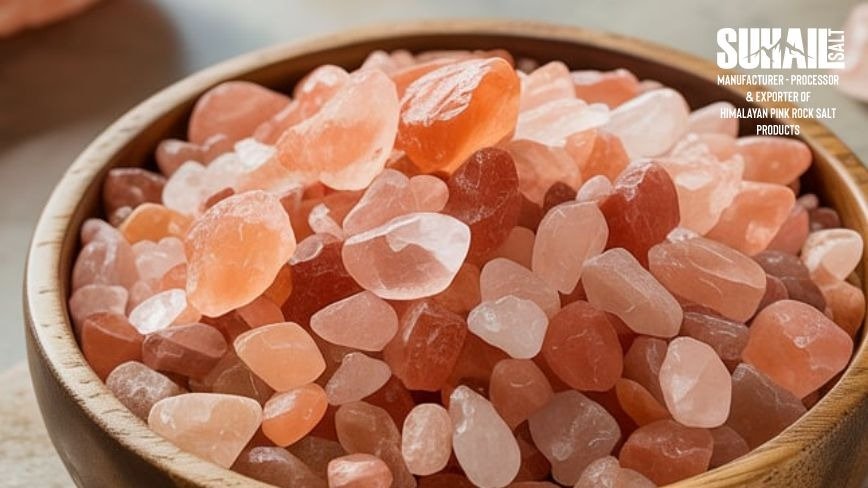
Himalayan pink salt comes from the Khewra Salt Mines in Punjab, Pakistan — the world’s second-largest salt mine, nestled at the foothills of the Salt Range mountains. Despite its name, Khewra is approximately 300 kilometres from the Himalayan range. The salt was formed roughly 250 million years ago when ancient shallow seas evaporated, leaving behind mineral-dense deposits sealed from modern pollution long before industrialisation existed.
The characteristic pink colour comes from trace amounts of iron oxide (rust) — entirely harmless and, in fact, an indicator of mineral richness.
Himalayan salt mineral profile
Khewra Mine — Punjab, Pakistan
- Sodium content ~36%
- Moisture content ~0.026%
- Trace minerals ~84
- Iron (Fe) High (pink colour)
- Potassium (K) Moderate
- Colour Pink to deep rose
- Texture Dry, crystalline
The mineral advantage
- Calcium (Ca) Present
- Magnesium (Mg) Present
- Potassium (K) Present
- Sulphur (S) Present
- Phosphorus (P) Present
- Boron, fluoride, zinc Trace
- Microplastic risk Very low
5 science-backed benefits of Himalayan salt
-
🩷Rich trace mineral profile. With up to 84 naturally occurring minerals, Himalayan salt offers the broadest mineral spectrum of any common salt. While many of these minerals are present in micro amounts, they contribute to what nutritionists call “mineral synergy” — the idea that minerals work more effectively together than in isolation.
-
🫁Halotherapy (respiratory health). Himalayan salt’s use in salt caves and salt inhalers — a practice called halotherapy — has been studied for its effects on asthma, allergies, and chronic bronchitis. While evidence varies, a 2020 review in the Journal of Medicine and Life found promising results for respiratory symptom relief in controlled halotherapy settings.
-
✨Ancient deposit purity. Because Himalayan salt was formed before modern agriculture, industrial pollution, and ocean microplastic contamination, it is often cited as the “purest” available salt. In the context of 2026’s growing microplastics awareness, this is an increasingly significant selling point.
-
🍽Exceptional finishing salt. Its dry, crystalline structure and mild, clean flavour make Himalayan salt ideal as a finishing salt — sprinkled on dishes just before serving. The larger pink crystals add visual appeal and a pleasant texture that most other salts cannot replicate.
-
🛁Versatile wellness applications. From Himalayan salt lamps and bath soaks to salt blocks for cooking, the mineral’s versatility has driven its adoption beyond the kitchen into the broader wellness market — a trend accelerating in 2026 with the mainstream growth of home wellness rituals.
Ready to make the switch? Our top-rated Celtic and Himalayan salt picks are sourced from verified, authentic origins.
Celtic vs. Himalayan vs. Table Salt: Full Comparison
The table below compares the three salts across every dimension that matters — from mineral content to environmental impact. This is the snapshot view nutritionists use to guide client recommendations.
| Feature | Celtic Salt | Himalayan Salt | Table Salt |
|---|---|---|---|
| Origin | Brittany, France | Punjab, Pakistan | Industrial mining / evaporation |
| Colour | Grey-white | Pink to deep rose | White |
| Sodium % | ~33% ✦ Lowest | ~36% | ~39% (highest) |
| Moisture | ~13% (moist) | ~0.026% (dry) | 0% (dry) |
| Trace minerals | ~34 minerals | ~84 minerals ✦ Most | ~2 minerals |
| Magnesium | High ✦ Best | Moderate | Stripped away |
| Iodine | Trace only | Trace only | Added (iodised) ✦ |
| Additives | None | None | Anti-caking agents |
| Microplastic risk | Low-moderate (current ocean) | Very low ✦ (ancient deposit) | Variable |
| Best use | Cooking, hydration, baths | Finishing, halotherapy, décor | Baking (precise sodium control) |
| Price tier | Mid–Premium | Mid–Premium | Budget |
| Environmental impact | Low ✦ (local, hand-harvested) | Moderate (7,000+ mile shipping) | Moderate |
Why Do Celtic and Himalayan Salt Win in 2026?
Celtic and Himalayan salt win in 2026 because they retain the full mineral spectrum your body needs — unlike processed table salt, which is stripped down to near-pure sodium chloride and treated with additives. As electrolyte awareness grows and microplastics become a health concern, these minimally processed, mineral-rich alternatives offer both superior nutrition and cleaner sourcing.
The 2026 context matters for three specific reasons:
1. Electrolyte nutrition is mainstream. The keto and carnivore movements — both accelerating in 2026 — demand higher mineral intake as carbohydrate restriction depletes electrolytes faster. Celtic and Himalayan salt provide the magnesium, potassium, and calcium these diets deplete.
2. Microplastics awareness is reshaping salt buying habits. Research into microplastics in sea salt has grown significantly since 2022. While Celtic salt (from current ocean waters) carries a low-to-moderate microplastic risk, Himalayan salt — sealed underground for 250 million years — has virtually none. This is now a primary decision factor for many shoppers.
3. Clean-label eating is the norm, not a trend. Consumers in 2026 read ingredients lists. The presence of sodium aluminium silicate in table salt is no longer something people are willing to quietly accept.
What Most Articles About Natural Salt Don’t Tell You
The iodine problem — the most important warning
Neither Celtic salt nor Himalayan salt contains enough iodine to meet your daily recommended intake. The World Health Organization (WHO) recommends 150 mcg of iodine per day for adults — critical for thyroid function, metabolism, and foetal brain development during pregnancy. If you replace iodised table salt entirely, you must obtain iodine from other sources: seaweed, fish, dairy, eggs, or an iodine supplement. Iodine deficiency remains the leading cause of preventable intellectual disability globally.
The microplastics nuance nobody mentions
A 2022 study found detectable levels of microplastics in 90% of commercial sea salts tested from current ocean sources — including some Celtic salts. This does not mean Celtic salt is dangerous; the concentrations are very low and the health impact of microplastics at these levels remains under study. However, if microplastics are a key concern, Himalayan salt’s ancient, pre-industrial deposit origin makes it the cleaner choice on this specific metric.
Price versus value
Celtic and Himalayan salt cost 5–15× more than table salt per kilogram. However, when you calculate the cost-per-mineral — considering that Celtic salt delivers 34 minerals versus table salt’s 2 — the value proposition shifts dramatically. Additionally, both salts have fuller flavour profiles, meaning many home cooks use less of them to achieve the same seasoning effect.
Celtic or Himalayan? How to Choose the Right Salt for You
Choose Celtic salt if…
- You want the highest magnesium and calcium content
- You cook most of your meals at home
- You do intense exercise and need electrolyte support
- You follow keto, carnivore, or a low-carb diet
- Reducing sodium intake is a priority
- You want a sustainable, low-carbon-footprint salt
- You use salt therapeutically in baths
Choose Himalayan salt if…
- You want the broadest trace mineral spectrum
- You use salt as a finishing touch on plated dishes
- Microplastic exposure is a priority concern for you
- You use halotherapy or salt inhalers
- Aesthetics and presentation matter (pink crystals)
- You cook on salt blocks or make salt lamps
- You prefer a dry, free-flowing texture
- Most nutrition experts suggest 1–2 teaspoons of natural salt per day spread across food and water for healthy adults (cite: Dr. Eric Berg)
- Individuals with hypertension, kidney disease, or heart conditions should follow their doctor’s personalises sodium recommendations
- For electrolyte water: ¼ tsp Celtic salt per 500ml water is a common starting point for hydration support
- Neither salt replaces iodised salt as an iodine source — factor this into your overall diet plan
- If you are pregnant, consult your midwife or OB before switching from iodised table salt
Frequently Asked Questions
Is Celtic salt better than Himalayan for hydration?
Can I use Celtic salt every day?
Does Himalayan salt help with thyroid function?
Which salt is lowest in sodium?
Can I replace iodised table salt with Celtic or Himalayan salt?
Is Himalayan salt actually from the Himalayas?
The Verdict: Both Win — for Different Reasons
Everyday cooking, electrolyte replenishment, lowest sodium content, highest magnesium, lowest carbon footprint, and therapeutic bath use. Best all-rounder for health-conscious home cooks and athletes.
Broadest mineral spectrum (84 minerals), lowest microplastic risk, halotherapy applications, finishing dishes aesthetically, and versatile wellness uses from salt lamps to cooking blocks.
What they share is more important than what divides them: both are unprocessed, additive-free, mineral-rich alternatives to a highly processed product that has been quietly stripped of everything valuable — and sold back to you for decades.
That, more than anything, is why nutritionists are making the switch.
Ready to upgrade your salt? Explore our top-tested picks for authentic Celtic and Himalayan salts — sourced from verified origins.