
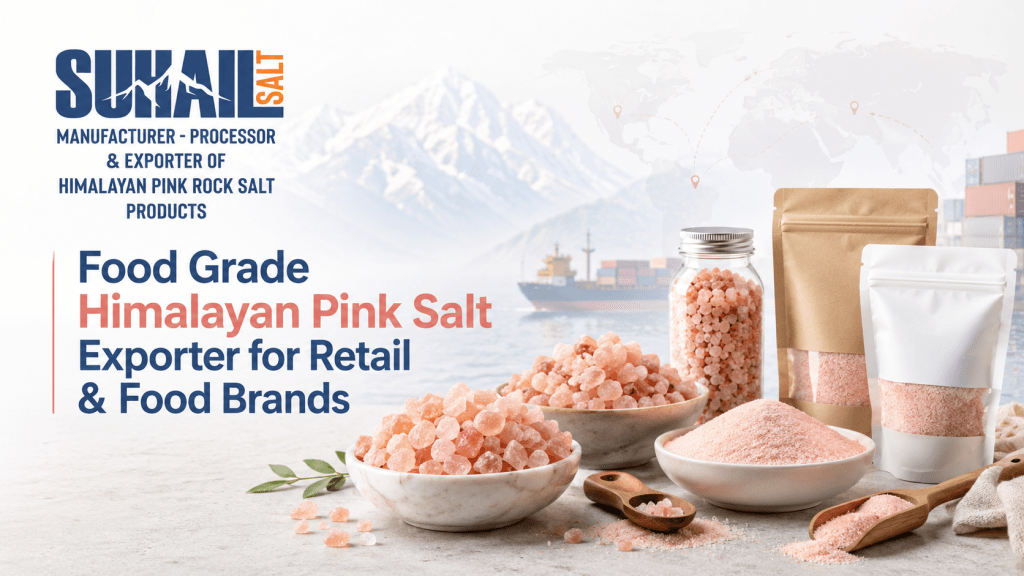
The global demand for natural, mineral-rich salts has skyrocketed over the past decade. At the center of this movement stands the food grade Himalayan pink salt exporter — a critical link between the ancient salt mines of Pakistan and health-conscious consumers, food brands, and retail chains across the world. Whether you operate a specialty grocery store, a gourmet food label, or a large-scale food manufacturing facility, choosing the right food grade rock salt supplier is one of the most important sourcing decisions your business will make.
This article covers everything you need to know — from what makes Himalayan pink salt food-grade, to how to evaluate suppliers, understand certifications, and select the right edible pink salt exporter for your brand.
|
�� Source Premium Food Grade Himalayan Pink Salt Today We supply ISO-certified, food-grade Himalayan pink salt to retail brands, food manufacturers, and distributors in 30+ countries. Custom packaging available. |
What Is Food Grade Himalayan Pink Salt?
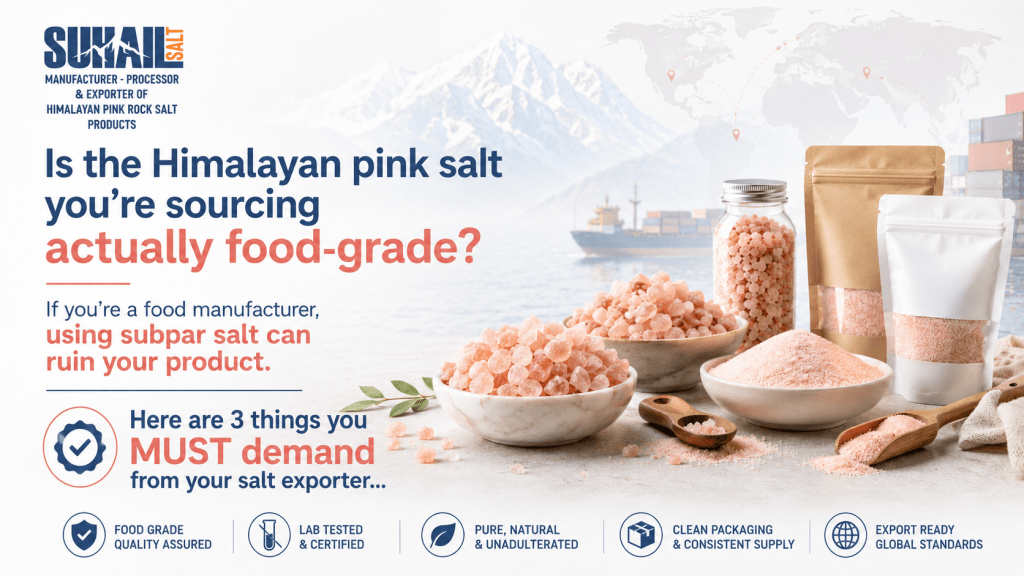
Not all Himalayan salt is created equal. Himalayan salt for food industry use must meet strict standards that separate it from decorative or industrial grades. Food-grade Himalayan pink salt is mined from the renowned Khewra Salt Mine in Punjab, Pakistan — one of the world’s oldest and largest salt deposits — and then carefully washed, dried, and processed under hygienic conditions to make it safe for direct human consumption.
Key characteristics of food grade pink salt include:
- • Absence of heavy metal contamination above permissible limits
- • Processed in food-safe, hygiene-controlled facilities
- • Free from artificial additives, anti-caking agents, or bleaching
- • Available in various grind sizes: fine, coarse, extra coarse, and powder
- • Tested and certified by recognized food safety authorities
The naturally pink hue comes from trace iron oxide and over 84 naturally occurring minerals. An authentic organic pink salt exporter ensures these mineral profiles are preserved throughout processing and packaging.
Why Global Brands Choose a Dedicated Food-Grade Rock Salt Supplier
Global food brands, supermarket chains, and health food retailers actively seek a dedicated food grade rock salt supplier rather than relying on commodity traders. Here is why:
1. Consistent Quality Assurance
A professional exporter invests in quality control at every stage — from raw salt extraction to final packaged delivery. They provide third-party lab test certificates (SGS, Intertek, or Bureau Veritas) confirming mineral composition, microbial safety, and absence of contaminants.
2. Regulatory Compliance
Importing countries have strict food import regulations. A qualified food-grade Himalayan pink salt exporter understands FDA (USA), EFSA (EU), FSANZ (Australia/NZ), and CFIA (Canada) requirements and prepares documentation accordingly — saving your compliance team significant time and risk.
3. Flexible Packaging & Private Labeling
Leading exporters offer full OEM/private-label services. Whether you need branded retail pouches, grinder bottles, bulk sacks, or premium gift jars, a specialized edible pink salt exporter delivers shelf-ready products tailored to your brand identity.
4. Scalable Supply Chains
As your distribution grows, your salt supplier must scale with you. Established exporters manage consistent production volumes, maintain buffer stock, and coordinate sea and air freight logistics to ensure timely delivery in any market.
|
�� Need Custom Private-Label Himalayan Salt Packaging? From branded retail pouches to bulk industrial sacks — we handle all custom packaging and OEM orders for food brands and distributors worldwide. |
Certifications Every Food Grade Himalayan Pink Salt Exporter Must Have
When evaluating a food grade rock salt supplier, certifications are your most reliable indicator of product safety and regulatory compliance. Here are the essential certificates to verify:
ISO 22000 — Food Safety Management
ISO 22000 ensures the exporter maintains a comprehensive food safety management system across the entire supply chain. This is a non-negotiable certification for supplying major retail chains and food manufacturers.
HACCP — Hazard Analysis Critical Control Points
HACCP certification demonstrates that the supplier identifies and controls potential food safety hazards at critical production stages. This is widely required by food industry buyers globally.
Halal & Kosher Certification
For markets in the Middle East, Southeast Asia, Europe, and North America, Halal and Kosher certifications significantly expand your product’s market eligibility and consumer trust.
GMP — Good Manufacturing Practices
GMP certification validates that the processing facility adheres to internationally recognized hygiene, safety, and quality standards during manufacturing.
FDA Registration & EU Compliance
For exporting to the USA, FDA facility registration is essential. For European markets, the Himalayan salt for food industry must comply with EU Regulation No. 178/2002 on general food safety principles.
How to Evaluate and Select the Right Edible Pink Salt Exporter
Not every supplier who claims to be a food grade Himalayan pink salt exporter can actually deliver at a professional level. Use this evaluation framework when shortlisting suppliers:
Step 1 — Verify Export History
Ask for documented proof of prior exports: shipping bills, Bills of Lading, and references from verified international buyers. A credible exporter openly shares their track record.
Step 2 — Request Lab Analysis Reports
Demand current third-party lab reports (within the past 6–12 months) confirming mineral profile, microbial count, heavy metal levels, and moisture content.
Step 3 — Inspect Packaging Standards
A professional edible pink salt exporter offers food-safe, moisture-resistant packaging that meets destination country labeling requirements including ingredient lists, nutritional facts, country of origin, and expiry dating.
Step 4 — Confirm Minimum Order Quantities (MOQ)
Align MOQ requirements with your business scale. Retail brands often start with 1–5 MT trial orders, while industrial food manufacturers typically procure 20–50 MT per shipment.
Step 5 — Assess Communication & Responsiveness
Your supplier must be responsive, transparent in pricing, and proactive in sharing shipping documentation. Delays in communication are a major red flag in international trade.
|
✅ Looking for a Certified Food Grade Himalayan Salt Supplier? Our facility is ISO 22000, HACCP, Halal, and Kosher certified. We export to 30+ countries with full documentation support for FDA, EU, and FSANZ compliance. |
Packaging Options Available from a Professional Food Grade Rock Salt Supplier
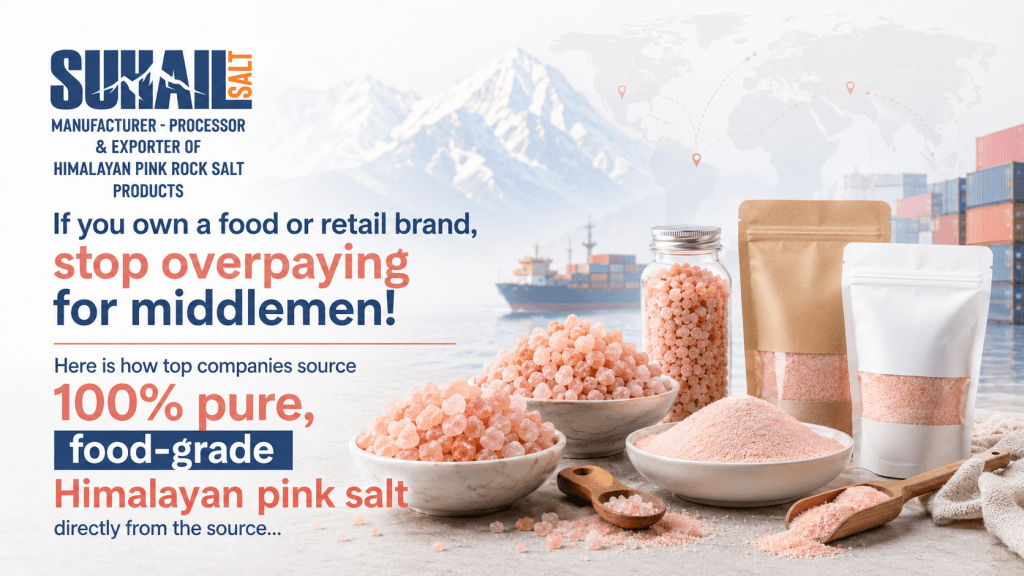
Packaging plays a critical role in shelf appeal, product safety, and market positioning. A full-service food-grade rock salt supplier offers a wide range of options tailored to different sales channels:
- • Retail Pouches (100g – 2kg): Resealable kraft or plastic pouches with custom label printing, ideal for supermarkets and specialty food stores
- • Grinder Bottles (50g – 500g): Glass or acrylic grinder jars for premium retail positioning in gourmet and health food channels
- • Bulk Poly Bags (5kg – 50kg): For food service, restaurant wholesale, and ingredient buyers
- • FIBC Jumbo Bags (500kg – 1500kg): For large-scale food manufacturers, processors, and ingredient distributors
- • OEM/Private Label: Complete custom branding, including logo, design, and nutritional panel formatting for your brand
A reliable organic pink salt exporter also ensures that all packaging materials are food-grade compliant, BPA-free where applicable, and suitable for the humidity and temperature conditions of destination markets.
Top Markets Importing Himalayan Salt for Food Industry Use
The global market for Himalayan salt for food industry applications continues to expand rapidly. The most active import markets include:
- • United States: The largest consumer market, with demand driven by health food trends, artisan food brands, and natural grocery chains like Whole Foods and Trader Joe’s
- • Germany & UK: Strong organic and clean-label food movements drive premium salt demand in European retail
- • Australia & New Zealand: Health-conscious consumers and strict FSANZ compliance requirements create demand for verified food-grade exporters
- • UAE & Saudi Arabia: Growing gourmet food culture and hospitality sector demand for Halal-certified natural salts
- • Canada: Rising natural health product sector with strong demand from Indian and Pakistani diaspora communities
- • Netherlands & France: Major EU redistribution hubs for Himalayan salt into broader European retail networks
|
�� Exporting to Your Market? We Know the Compliance Requirements Whether you import into the USA, EU, Australia, UAE, or Canada, we prepare all necessary food safety documentation, certificates of origin, and FDA/EU-compliant labeling. �� Tell Us Your Target Market — Get Compliance Details Instantly |
Search Intent Analysis: What Buyers Are Really Looking For
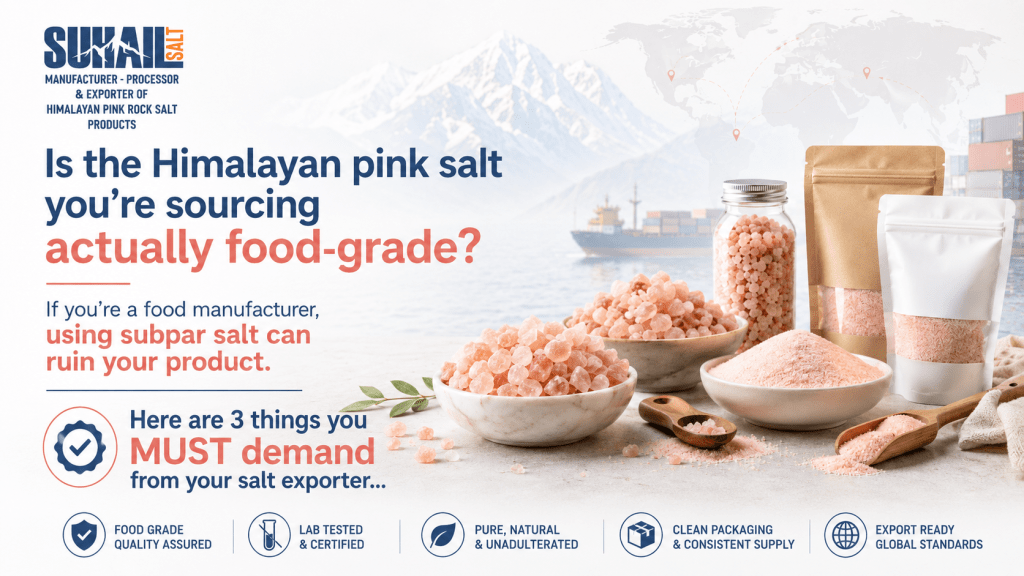
Understanding search intent behind queries like “food grade Himalayan pink salt exporter” reveals three core buyer types:
1. Commercial Buyers (Transactional Intent)
These are procurement managers, import-export traders, and food brand owners actively seeking a supplier to place orders. They search for pricing, MOQs, certifications, and sample requests. Your website and export profile must deliver clear product specs and a fast quote process.
2. Brand Owners Researching Suppliers (Investigational Intent)
These buyers are comparing multiple exporters before making a decision. They seek comparison content, certification details, packaging options, and case studies from similar brands. Educational content — like this article — builds authority and trust at this stage.
3. Importers Verifying Legitimacy (Navigational Intent)
Importers in regulated markets (USA, EU, Australia) often search for specific certifications, blacklisted suppliers, or country-of-origin documentation. Transparent certification publishing, SGS report availability, and verified testimonials are critical here.
People Also Ask: 15 Top Questions About Food Grade Himalayan Pink Salt Exporter
These are the most commonly searched questions by buyers and importers worldwide, ranked from highest to lowest search demand:
| Question | Answer |
1. What is a food-grade Himalayan pink salt exporter? |
A food-grade Himalayan pink salt exporter is a certified supplier that sources, processes, and ships edible-grade pink rock salt from the Khewra mines in Pakistan to global retail chains, food manufacturers, and distribution companies under strict food safety standards. |
2. Which country exports the most Himalayan pink salt? |
Pakistan is the world’s leading exporter of Himalayan pink salt. The Khewra Salt Mine in Punjab is the largest source, supplying the majority of global food-grade and industrial pink rock salt exports. |
3. Is Himalayan pink salt safe to eat? |
Yes. Food-grade Himalayan pink salt is completely safe for human consumption. It contains over 84 natural trace minerals, has no artificial additives, and is commonly used as a healthier alternative to refined table salt. |
4. How do I find a reliable edible pink salt exporter? |
Look for exporters with food safety certifications (ISO 22000, HACCP, FDA-compliant packaging), a verifiable export history, transparent pricing, third-party lab test reports, and strong client references in your target market. |
5. What certifications should a food grade rock salt supplier have? |
A trustworthy food-grade rock salt supplier should hold ISO 22000, HACCP, Halal, Kosher, and GMP certifications. FDA-compliant labeling and SGS/Intertek quality reports are strong additional indicators of credibility. |
6. What is the minimum order quantity for Himalayan salt export? |
Most Himalayan salt exporters accept MOQs starting from 1 metric ton for retail packaging. Bulk industrial orders typically start at 5–25 metric tons, while private-label food brand orders vary by packaging specifications. |
7. What are the different grades of Himalayan pink salt? |
Himalayan pink salt is available in food-grade (edible), industrial-grade (used in lamps, bath products), and spa/cosmetic grade. Food-grade is processed under strict hygiene controls and is suitable for direct human consumption. |
8. Can I get private-label Himalayan salt packaging for my brand? |
Yes. Most food-grade Himalayan pink salt exporters offer custom OEM/private-label packaging, including branded pouches, jars, grinder bottles, and bulk sacks. Minimum quantities and lead times vary by supplier. |
9. What is the price of food-grade Himalayan pink salt per kg? |
The wholesale price of food-grade Himalayan pink salt typically ranges from $0.30 to $1.50 per kg, depending on order volume, grind size, and packaging type. Retail-ready packaged products command higher prices. |
10. How is Himalayan pink salt different from regular sea salt? |
Himalayan pink salt is mined from ancient rock formations and contains 84+ trace minerals, giving it a pink hue. Sea salt is evaporated from ocean water and may contain microplastics. Himalayan salt is considered purer and more mineral-rich. |
11. Is the organic pink salt exporter a real certification? |
Himalayan salt is naturally mineral-rich and unprocessed, but technically ‘organic’ as a certification applies to farmed products. Reputable organic pink salt exporters use the term to indicate additive-free, chemical-free, and minimally processed product standards. |
12. What documents are required for Himalayan salt export? |
Standard export documents include a commercial invoice, packing list, certificate of origin, phytosanitary/health certificate, food safety lab analysis report, and bill of lading. Some markets also require FDA registration or EU food safety compliance documentation. |
13. What packaging options are available for Himalayan salt export? |
Exporters offer a wide range of packaging: retail pouches (100g–1kg), grinder bottles, bulk poly bags (25kg–50kg), FIBC jumbo bags (1–1.5 tons), and custom-printed private label options for food brands. |
14. Which countries import the most Himalayan pink salt? |
The top importing countries for Himalayan pink salt are the USA, Germany, UK, Australia, Canada, UAE, France, and the Netherlands. Demand is rising in health-conscious markets across North America and Western Europe. |
15. How long does Himalayan pink salt take to export from Pakistan? |
From order confirmation, Himalayan salt exports from Pakistan typically take 2–4 weeks for processing and packaging, plus 20–30 days sea freight transit time to major global ports. Air freight is faster but more expensive. |
Conclusion: Partner With a Trusted Food-Grade Himalayan Pink Salt Exporter
The global appetite for natural, mineral-rich, and clean-label ingredients shows no sign of slowing down. Aligning your brand with a trusted, certified food grade Himalayan pink salt exporter is not just a sourcing decision — it is a strategic investment in your product quality, regulatory compliance, and brand reputation.
From verifying certifications like ISO 22000 and HACCP, to customizing private-label packaging, to navigating FDA and EU import compliance, the right edible pink salt exporter acts as a true business partner — not just a vendor. As you evaluate your options, prioritize transparency, documentation quality, and communication. Those three factors separate world-class food grade rock salt suppliers from the rest.
Whether you are launching a new gourmet salt brand, scaling an existing product line, or sourcing Himalayan salt for food industry manufacturing, Pakistan’s Himalayan salt mines — paired with the right export partner — offer an unmatched combination of quality, mineral purity, and global supply chain capability.
|
�� Ready to Source Food Grade Himalayan Pink Salt for Your Brand? Join 200+ food brands and distributors who trust us as their dedicated Himalayan pink salt export partner. ISO certified. Fast quotes. Full documentation support. �� Get Your Free Quote & Sample Pack — Contact Our Export Team Today |