
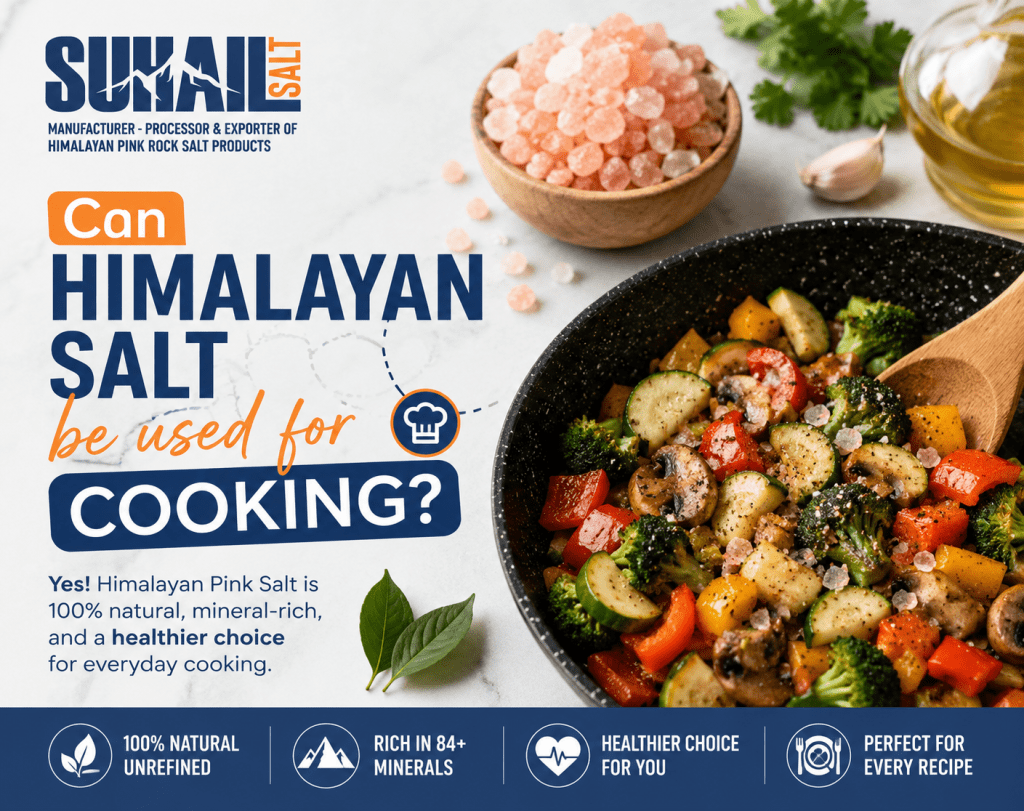
Himalayan salt can be used for cooking in almost every way that ordinary table salt or sea salt is used — from everyday seasoning to grilling, baking, curing, and even cooking directly on heated salt blocks. Sourced from ancient mineral-rich deposits in the Punjab region of Pakistan, this pink-hued salt has become a kitchen staple for home cooks, professional chefs, and food manufacturers worldwide.
|
QUICK ANSWER Yes, Himalayan salt can be used for cooking. It works as a 1:1 substitute for table salt in most recipes, and its coarser grades are ideal for grilling, brining, and finishing dishes. Suhail Salt supplies bulk Himalayan pink salt for culinary use to importers and food businesses worldwide. |
In this guide, we’ll cover exactly how to use Himalayan pink salt in cooking, compare it with other salts, walk through practical applications, and answer the most common questions buyers and home cooks ask before purchasing in bulk.
What Makes Himalayan Salt Different From Table Salt?
Himalayan pink salt is mined from the Khewra Salt Mine, one of the oldest and largest salt deposits on earth, located in the foothills of the Punjab region of Pakistan. Geologists estimate these deposits formed hundreds of millions of years ago, when ancient seabeds were compressed under layers of rock and gradually crystallized. Unlike heavily processed table salt,
it is extracted in large crystal form and minimally refined, which preserves trace minerals such as iron, magnesium, calcium, and potassium. These minerals are also responsible for its characteristic pink to deep red color, which can range from pale blush to a richer salmon tone depending on mineral concentration.
Because it retains a coarser, more irregular crystal structure, Himalayan salt dissolves slightly slower than fine table salt, which many chefs say gives more controlled seasoning and a cleaner, less metallic taste on the palate. This slower dissolution also makes it easier to avoid over-salting, since the flavor builds gradually rather than hitting all at once.
Another distinction is processing. Most table salt is mechanically refined and treated with anti-caking agents, and in many countries it is fortified with iodine. Himalayan salt, by contrast, is typically sold in its natural state, hand-sorted, and crushed to the desired grain size without chemical additives — a point that matters to buyers focused on clean-label and minimally processed ingredients.
Key Differences at a Glance
| Salt Type | Best Cooking Use | Mineral Content |
| Himalayan Pink Salt | Finishing, grilling, brining, baking | 84+ trace minerals |
| Table Salt | General seasoning, baking (with iodine) | Mostly sodium chloride, additives |
| Sea Salt | Finishing, salads | Varies by source, fewer trace minerals |
| Kosher Salt | Cooking, koshering meat | Mostly sodium chloride, no additives |
|
Source Bulk Himalayan Salt for Your Kitchen or Brand Suhail Salt supplies food-grade Himalayan pink salt in custom grain sizes for restaurants, retailers, and private label brands. → Request a Wholesale Quote |
How Can Himalayan Salt Be Used for Cooking at Home?
Himalayan pink salt can replace ordinary salt in virtually any recipe. The main consideration is grain size — fine culinary salt works for everyday seasoning and baking, while coarse and block forms are better suited to grilling, curing, and finishing.
1. Everyday Seasoning
Use fine-ground Himalayan pink salt exactly as you would table salt — in soups, sauces, marinades, and general seasoning. Because it has a milder, rounder flavor, many cooks find they can use a similar quantity without the harsh aftertaste sometimes associated with iodized salt. It works equally well stirred into pasta water, sprinkled over roasted vegetables, or whisked into salad dressings.
2. Grilling and Searing
Coarse Himalayan salt crystals are popular for dry rubs and grilling because they create a flavorful crust on meat and vegetables without dissolving too quickly under high heat. The larger crystals cling to the surface of steaks, chops, and skewers, releasing flavor gradually as the food cooks rather than washing away in marinade or grill juices.
3. Cooking on a Himalayan Salt Block
Solid Himalayan salt blocks can be heated gradually and used as a cooking surface for searing shrimp, thin cuts of meat, or vegetables, infusing food with a subtle mineral seasoning directly from the slab. Salt blocks also retain heat well, making them useful for tableside presentation, and can be chilled for serving cold appetizers like sushi or charcuterie.
4. Brining and Curing
Because Himalayan salt is free from anti-caking agents found in some table salts, it dissolves cleanly in brine solutions for poultry, pork, and fish, helping retain moisture during cooking. It is also commonly used in dry-curing recipes for bacon, gravlax, and charcuterie, where additive-free salt is preferred to avoid interfering with the curing process.
5. Baking
Fine Himalayan pink salt works well in bread, pastry, and baked goods, balancing sweetness and strengthening gluten structure just as standard salt does. Bakers often favor it for finishing touches as well, such as a light sprinkle over caramel desserts or artisan loaves before baking.
|
Need Custom Grain Sizes for Food Production? From fine culinary powder to coarse grilling crystals, Suhail Salt manufactures to your exact specification with full export documentation. → Talk to Our Export Team |
Is Himalayan Salt Healthier for Cooking Than Regular Salt?
Nutritionally, Himalayan salt and table salt are both composed mostly of sodium chloride, so neither should be considered a significant source of minerals on its own — the trace mineral content is too small to meaningfully affect daily nutrition. A typical serving contributes only negligible amounts of iron, magnesium, or calcium compared to a balanced diet. However, Himalayan pink salt typically contains no synthetic anti-caking agents or additives, and many consumers prefer it for its natural processing and flavor profile.
As with any salt, moderation matters. Health authorities generally recommend limiting total sodium intake regardless of salt source, so Himalayan salt should be used as a flavorful alternative rather than a health supplement. For people managing blood pressure or following a low-sodium diet, switching salt types alone will not significantly change sodium intake; portion control remains the key factor.
Grades Suhail Salt Supplies for Culinary Use
| Grade | Grain Size | Common Cooking Use | Typical MOQ |
| Culinary Fine | 0.5–1 mm | Every day seasoning, baking | 1,000 kg |
| Culinary Coarse | 2–5 mm | Grilling, rubs, brines | 1,000 kg |
| Block & Plate Salt | Solid block | Searing, serving, curing | 500 pcs |
| Salt Slabs (Cooking) | Custom cut | Direct-heat cooking, chilling | 500 pcs |
Where to Buy Himalayan Pink Salt in Bulk for Cooking?
Restaurants, food manufacturers, retailers, and private label brands typically source Himalayan salt directly from exporters near the Khewra mining region to reduce costs and ensure consistent quality. Buying directly from a manufacturer also shortens the supply chain, which helps maintain freshness and reduces the markup typically added by intermediary distributors.
Suhail Salt manufactures and exports food-grade Himalayan pink salt in custom grain sizes, packaging, and private label formats, with documentation for international food safety compliance. We work with importers, distributors, and food service businesses across multiple regions, offering flexible minimum order quantities to suit both established buyers and businesses placing their first bulk order.
|
Get a Free Sample Before You Order See and taste the quality of Suhail Salt’s culinary-grade Himalayan pink salt before committing to a bulk order. → Request a Free Sample |
How Should You Store Himalayan Salt for Cooking?
Himalayan pink salt is naturally low-moisture and shelf-stable, but it should be kept in an airtight container away from humidity to prevent clumping. A cool, dry pantry shelf is ideal; avoid storing it near the stove or sink, where steam and moisture can accumulate over time. Salt blocks should be dried thoroughly after each use and stored in a dry area to avoid cracking from repeated temperature changes — sudden shifts from hot to cold are the most common cause of block fracturing.
Unlike many pantry staples, Himalayan salt does not spoil or lose potency over time, which makes it practical for both households and food businesses to purchase in larger quantities without concern for waste.
Culinary Grade vs. Other Himalayan Salt Products
Not all Himalayan salt products are intended for cooking. The same mineral deposits are also processed into bath salts, decorative lamps, and spa products, which are not food-grade and should never be used in the kitchen. When sourcing for culinary use, buyers should confirm the product is specifically labeled and certified as food-grade salt, since processing and purity standards differ significantly between cosmetic and edible grades.
Suhail Salt maintains separate production lines for culinary, decorative, and industrial-grade salt, ensuring that food-grade orders meet the purity and handling standards required for human consumption.
|
Private Label Himalayan Salt for Your Brand Launch your own branded salt product with Suhail Salt’s private label manufacturing and packaging services. → Explore Private Label Options |
Common Mistakes to Avoid When Cooking With Himalayan Salt
Even experienced cooks occasionally misuse Himalayan salt, particularly when switching from fine table salt for the first time. The most frequent error is measuring by volume instead of weight, because Himalayan salt crystals are often larger and less dense than table salt. A teaspoon of coarse Himalayan salt contains less actual sodium than a teaspoon of fine table salt, so recipes may need slight adjustment.
Another common mistake is heating a salt block too quickly. Rapid temperature changes can cause cracking, so blocks should be warmed gradually over 15 to 20 minutes before reaching cooking temperature. Finally, using non-food-grade Himalayan salt products, such as those intended for bath soaks or decorative purposes, in cooking should always be avoided, as these are not processed or certified for consumption.
People Also Ask: Himalayan Salt Can Be Used for Cooking
Below are the most frequently searched questions related to using Himalayan salt in cooking, ranked from highest to lowest search demand.
Can you cook with Himalayan pink salt?
Yes, Himalayan pink salt can be used for cooking in the same way as table or sea salt — for seasoning, grilling, baking, and brining.
Is Himalayan salt better than regular salt for cooking?
Himalayan salt offers a milder flavor and contains no synthetic additives, but nutritionally it is similar to regular salt; the choice mostly comes down to taste and texture preference.
Can Himalayan salt be used instead of table salt?
Yes, Himalayan salt can replace table salt in nearly any recipe at a similar ratio, though grain size may affect how quickly it dissolves.
Is it safe to cook on a Himalayan salt block?
Yes, when heated gradually and used correctly, Himalayan salt blocks are safe for searing and cooking food directly on the surface.
Does Himalayan salt taste different when cooking?
Many cooks describe Himalayan salt as having a milder, less harsh flavor compared to iodized table salt, due to its mineral composition.
Can you use Himalayan salt for baking bread?
Yes, fine-ground Himalayan salt works well in bread and baked goods, helping control yeast activity and enhance flavor.
How do you use a Himalayan salt block for cooking?
Heat the block gradually on a stovetop or grill, then use it to sear proteins or vegetables for a few minutes per side.
Is pink Himalayan salt good for grilling?
Yes, coarse Himalayan salt crystals are commonly used as a dry rub or seasoning base for grilled meats and vegetables.
Can Himalayan salt be used for brining meat?
Yes, Himalayan salt dissolves cleanly in brine solutions and is widely used for brining poultry, pork, and fish.
Does Himalayan salt have less sodium than table salt?
No, Himalayan salt contains a similar amount of sodium by weight as table salt; the mineral content does not significantly reduce sodium levels.
What is the difference between Himalayan salt and sea salt for cooking?
Himalayan salt is mined from ancient underground deposits, while sea salt is harvested from evaporated seawater; both can be used similarly in cooking, though mineral content and flavor vary.
Can you use Himalayan salt for canning or pickling?
Plain, additive-free Himalayan salt can be used for pickling, though it’s recommended to use a finely ground variety for even dissolving in brine.
Is Himalayan pink salt food grade?
Yes, Himalayan pink salt sold for culinary use is processed and certified as food grade, meeting international food safety standards.
How long does Himalayan salt last in the kitchen?
Himalayan salt does not expire and remains stable indefinitely when stored in a dry, airtight container.
Where can I buy bulk Himalayan salt for a restaurant?
Restaurants and food businesses can source bulk Himalayan salt directly from exporters and manufacturers such as Suhail Salt for a cost-effective, consistent supply.
|
Ready to Source Premium Himalayan Salt? Suhail Salt exports food-grade Himalayan pink salt worldwide with flexible MOQs, custom packaging, and full documentation support. → Get a Bulk Pricing Quote Today |
Conclusion: Himalayan Salt Can Be Used for Cooking With Confidence
To summarize, Himalayan salt can be used for cooking across nearly every culinary application — from daily seasoning and baking to grilling, brining, and direct-heat block cooking. Its natural mineral composition, additive-free processing, and versatile grain sizes make it a preferred choice for home kitchens and commercial food businesses alike. For bulk sourcing, private label manufacturing, or wholesale export of food-grade Himalayan pink salt, Suhail Salt offers a reliable supply with international compliance and custom specifications.