
Finding a reliable best pink salt exporter is one of the most critical decisions you will make when sourcing Himalayan salt for your business. The global market is flooded with suppliers making bold claims, but not all deliver consistent quality, proper certifications, or transparent pricing.
This guide walks you through everything you need to know on how to choose himalayan pink salt exporter — from verifying product quality and certifications to understanding the export process and comparing wholesale pricing. Whether you are a food brand, spa supplier, or bulk distributor, this himalayan salt buying guide will help you make a confident, informed decision.
Use these steps to evaluate any best pink salt exporter before committing to your first or next bulk order.
|
Suhail Salt — Pakistan’s #1 Himalayan Salt Manufacturer & Exporter | Wholesale Supplier Get a free wholesale quote tailored to your product specifications and volume. |
Why Choosing the Right Himalayan Pink Salt Exporter Matters
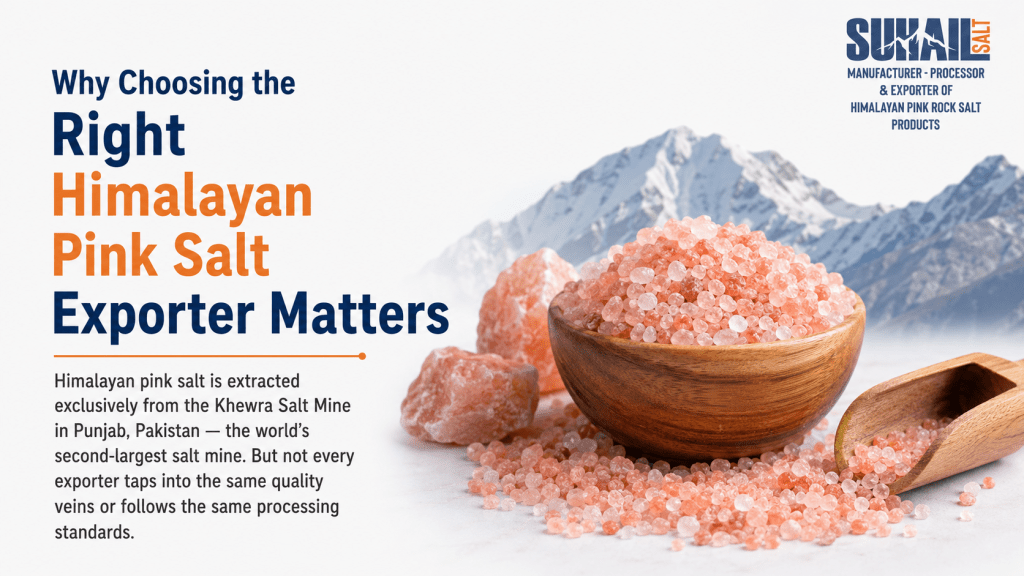
Himalayan pink salt is extracted exclusively from the Khewra Salt Mine in Punjab, Pakistan — the world’s second-largest salt mine. But not every exporter taps into the same quality veins or follows the same processing standards.
Sourcing from an unverified supplier can result in adulterated salt, inconsistent grain sizes, contaminated batches, or packaging that fails international retail standards. For food brands, this means regulatory trouble. For spa products, it means customer complaints. The right exporter protects your brand, ensures supply chain reliability, and saves you costly product returns.
Understanding how to import pink salt from Pakistan starts with knowing what separates a professional exporter from a middleman broker.
1. Verify the Exporter’s Source and Mining Credentials
Authentic Himalayan pink salt must come from the Khewra region in Pakistan. The first step when evaluating the best pink salt exporter is verifying their direct sourcing from this region. Reputable exporters like Suhail Salt operate with documented ties to Khewra and provide full transparency about raw material sourcing.
- • Request a Certificate of Origin verifying the Pakistani Himalayan salt source
- • Ask for mine-site photos, GPS coordinates, or third-party sourcing audits
- • Avoid exporters who cannot name their specific mine or salt deposit
- • Cross-check supplier listings against Pakistan’s salt export quality standards regulatory databases
2. Evaluate Salt Export Quality Standards and Certifications
International markets — especially the EU, USA, Australia, and Canada — demand strict compliance with food safety and quality certifications. A credible Himalayan salt exporter must hold certifications that validate their product’s safety, purity, and origin.
When studying how to choose himalayan pink salt exporter partners, always request documentation for the following:
| Certification | Why It Matters |
| ISO 22000 | Food safety management system compliance |
| HACCP | Hazard analysis and critical control points for food processing |
| Halal Certification | Required for Muslim-majority markets and global halal food brands |
| Kosher Certification | Necessary for Jewish markets and specialty food retailers |
| FSSC 22000 | Advanced food safety for European and US retail supply chains |
| SGS / Intertek Lab Reports | Third-party chemical composition and purity validation |
| PSQCA Approval | Pakistan Standards & Quality Control Authority certification |
Do not accept verbal assurances. Demand actual certification documents and verify them with the issuing bodies. This step distinguishes professional exporters from informal brokers, who often lack proper documentation.
|
ISO 22000 | HACCP | Halal | Kosher | SGS Lab Verified | PSQCA Approved All documents available on request. Verified quality for 50+ export markets worldwide. |
3. Assess Product Range and Customization Capability
A professional best pink salt exporter should offer a wide product range and flexible customization. Your exporter’s production capacity directly impacts your ability to scale and diversify. A comprehensive himalayan salt buying guide always checks product depth before committing to a supplier.
- • Edible salt: fine, coarse, and extra-coarse grain sizes (0.5mm to 10mm)
- • Salt lamps and night lights: various shapes, sizes, and wattages
- • Cooking salt blocks and plates: different dimensions for retail and food service
- • Bath salt and spa products: flakes, Epsom blends, and private-label pouches
- • Animal lick salt: compressed blocks for livestock nutritional programs
- • Industrial salt: for de-icing, water softening, and chemical processing
- • Custom private-label packaging: bags, jars, pouches, and canisters in custom designs
Request a comprehensive product catalogue and minimum order quantities (MOQs) before committing. A reliable exporter will accommodate your product mix without unnecessarily enforcing high minimums on every SKU.
4. Understand How to Import Pink Salt from Pakistan — Logistics and Documentation
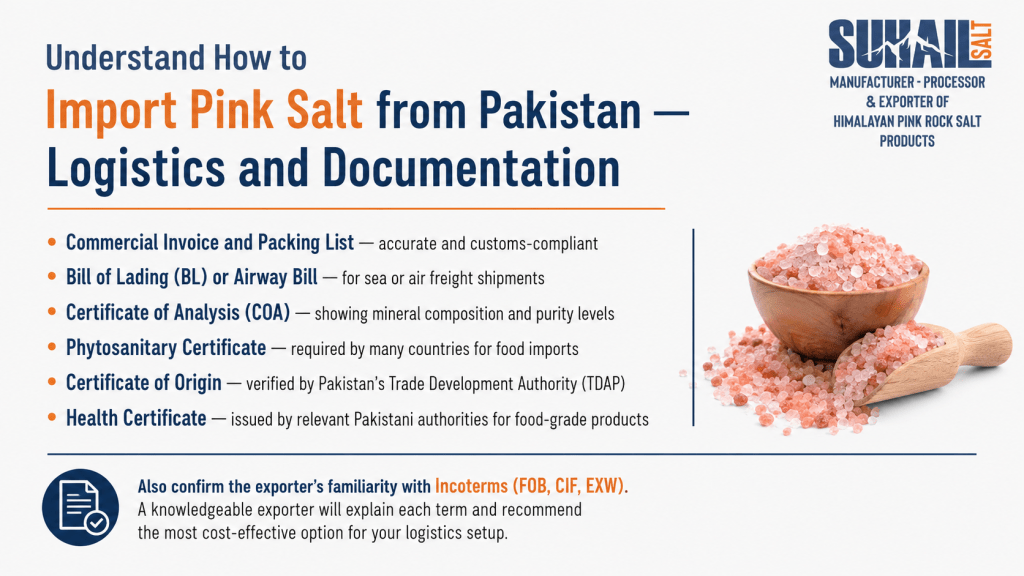
Navigating international trade requires more than finding a good supplier. You need an exporter who handles logistics professionally and provides complete shipping documentation to avoid customs delays at destination ports.
- • Commercial Invoice and Packing List — accurate and customs-compliant
- • Bill of Lading (BL) or Airway Bill — for sea or air freight shipments
- • Certificate of Analysis (COA) — showing mineral composition and purity levels
- • Phytosanitary Certificate — required by many countries for food imports
- • Certificate of Origin — verified by Pakistan’s Trade Development Authority (TDAP)
- • Health Certificate — issued by relevant Pakistani authorities for food-grade products
Also confirm the exporter’s familiarity with Incoterms (FOB, CIF, EXW). A knowledgeable exporter will explain each term and recommend the most cost-effective option for your logistics setup.
5. Compare Pricing Transparency and Wholesale Terms
Pricing in the Himalayan salt trade varies significantly based on product type, grain size, packaging, and order volume. Always get itemized pricing that breaks down product cost, packaging cost, and freight separately as part of your himalayan salt buying guide.
Beware of exporters offering suspiciously low prices — this often signals lower purity salt, substandard packaging, or hidden fees added at shipment.
- • What is the per-kg or per-ton price for each product grade?
- • Are packaging costs included or charged separately?
- • What are the MOQs per SKU and for total container orders?
- • Are there volume discounts for repeat or bulk orders?
- • What payment terms apply — T/T, LC, or advance payment?
- • Is the price guaranteed at the time of order or subject to revision at shipment?
|
Transparent pricing, no hidden fees, flexible MOQs, and volume discounts for bulk buyers. FOB Karachi | CIF Global Ports | Full Documentation Included |
6. Evaluate Packaging Quality and Private Label Options
Packaging is your brand’s first impression on the retail shelf. When choosing a himalayan pink salt exporter, review their packaging capabilities in detail. Poor packaging leads to product damage during transit, moisture absorption, and brand damage at the point of sale.
A credible exporter should offer multilayer poly bags, food-grade kraft bags, glass or PET jars, vacuum-sealed pouches, and custom-branded packaging with your logo, barcodes, and nutritional labels ready for retail markets worldwide.
Ask for physical packaging samples before placing your first order. Professional exporters like Suhail Salt offer full private-label services, including custom design support.
7. Check Export Experience, References, and Market Reputation
Export experience is a strong indicator of reliability. A company that has successfully shipped to North America, Europe, or Australia has already navigated complex customs and compliance environments. This track record is invaluable when you study how to choose Himalayan pink salt exporter partners.
Request references from existing international clients, especially those in your target market. Look for verifiable testimonials, export data through platforms like Panjiva or ImportGenius, and a professional online presence.
Verify the exporter’s registration with Pakistan’s TDAP (Trade Development Authority of Pakistan). An unregistered supplier cannot legally export commercial volumes and represents a significant supply chain risk.
8. Assess Communication, Response Time, and Business Culture
Your exporter is a long-term business partner, not just a one-time vendor. Evaluate their communication style during the inquiry phase — how quickly they respond, how clearly they answer technical questions, and whether they proactively share relevant documentation.
Red flags in communication include delayed responses beyond 48 hours, vague answers about certifications, reluctance to share references, and pressure tactics to close orders quickly. A professional best pink salt exporter will welcome scrutiny because they have nothing to hide.
The best Pakistani exporters have English-fluent export teams who understand Western business protocols and can support smooth communication from inquiry through delivery.
|
Fast response guaranteed. English-speaking export consultants for US, EU, UK, Australia & Canada. Let’s discuss your requirements — no obligation, no pressure. |
9. Request Lab Reports and Product Samples Before Committing
Never place a bulk order without reviewing a lab-verified Certificate of Analysis and physical product samples. The COA should confirm the salt’s NaCl content (minimum 97% for food-grade), trace mineral composition, heavy metal absence, and microbiological safety.
Physical samples let you evaluate color consistency, grain size uniformity, moisture levels, and packaging quality firsthand. A confident exporter sends samples readily because they trust their quality will win your business.
- • Request at least 3 grain-size samples for each product category
- • Ask for sealed samples in final export packaging, not loose samples in zip bags
- • Test samples with a third-party lab in your country if you have regulatory concerns
- • Compare the sample against the COA to verify accurate product representation
10. Confirm After-Sales Support and Dispute Resolution Policy
Clarify dispute resolution policies before signing any agreement. A trustworthy exporter will have a clear policy for short-shipped goods, damaged batches, documentation errors, or quality discrepancies. Get this in writing as part of your purchase agreement.
Professional Pakistani salt exporters who value long-term relationships will offer credit notes, replacement shipments, or partial refunds depending on the nature of the issue. Long-term partnerships deliver better pricing, priority allocation, and dedicated account support.
|
Pakistan’s #1 Himalayan Salt Manufacturer & Exporter | Wholesale Supplier 10+ Years of Export Excellence | 50+ Countries Served | Full Private Label & Custom Packaging |
People Also Ask: How to Choose Himalayan Pink Salt Exporter
Q: What is the best country to import Himalayan pink salt from? |
| A: Pakistan is the only authentic source of genuine Himalayan pink salt. The Khewra Salt Mine in Punjab, Pakistan, is where all authentic Himalayan pink salt originates. Any product claiming to be Himalayan pink salt but sourced outside Pakistan is not authentic. |
Q: How do I verify a Himalayan salt exporter is legitimate? |
| A: Verify legitimacy by checking their TDAP registration, requesting ISO or HACCP certifications, reviewing their export history through platforms like Panjiva or ImportGenius, and requesting references from existing international buyers. |
Q: What certifications should a Himalayan pink salt exporter have? |
| A: Essential certifications include ISO 22000, HACCP, Halal, Kosher, PSQCA approval, and third-party lab reports from SGS or Intertek. FSSC 22000 is required for many European retail chains. |
Q: How do I import Himalayan pink salt from Pakistan? |
| A: To import pink salt from Pakistan, identify a certified exporter, request samples and COA, confirm shipping terms (FOB or CIF), arrange freight forwarding, and ensure all customs documentation — including Certificate of Origin and Phytosanitary Certificate — is complete before shipment. |
Q: What is the minimum order quantity for Himalayan pink salt export? |
| A: MOQs vary by exporter and product type. Most professional exporters accept orders starting from 1 metric ton for samples or small shipments, with full container loads (20FCL = approx 20 tons) offering the best per-unit pricing. |
Q: How much does it cost to import Himalayan salt from Pakistan? |
| A: Himalayan salt FOB prices typically range from USD 0.15 to USD 0.80 per kg depending on grade, processing, and packaging. Add freight, customs duties, and compliance costs for your total landed cost calculation. |
Q: What documents are needed to import pink salt from Pakistan? |
| A: Required documents include Commercial Invoice, Packing List, Bill of Lading, Certificate of Origin (TDAP verified), Certificate of Analysis, Phytosanitary Certificate, and Health Certificate issued by Pakistani authorities. |
Q: Is Himalayan pink salt from Pakistan FDA approved? |
| A: Himalayan pink salt is generally recognized as safe (GRAS) by the FDA as a food-grade mineral salt. However, individual exporters must meet FDA import requirements. Look for exporters with FDA Food Facility Registration if targeting the US market. |
Q: What are the quality standards for Himalayan salt exports? |
| A: Quality standards require minimum 97% NaCl content for food-grade salt, absence of heavy metals above permissible limits, microbiological safety compliance, and proper moisture levels. Third-party COAs from SGS or Intertek are the benchmark for salt export quality standards. |
Q: How do I find a reliable pink salt wholesale supplier in Pakistan? |
| A: Search TDAP’s verified exporter directory, attend international trade fairs like SIAL or Gulfood, use B2B platforms like Alibaba with verified badges, or directly contact established manufacturers like Suhail Salt who specialize in Himalayan salt exports. |
Q: What is the difference between Himalayan pink salt and regular table salt? |
| A: Himalayan pink salt contains 84+ trace minerals including calcium, magnesium, and potassium, giving it its characteristic pink color. Regular table salt is refined sodium chloride with added iodine and anti-caking agents, lacking the full mineral profile. |
Q: Can I get private label Himalayan salt packaging from Pakistani exporters? |
| A: Yes. Leading Pakistani exporters like Suhail Salt offer full private-label services, including custom packaging design, branded bags, jars, and pouches with your logo, nutritional information, and barcodes ready for retail shelves worldwide. |
Q: What is the shelf life of exported Himalayan pink salt? |
| A: Himalayan pink salt has an indefinite shelf life when stored in cool, dry conditions away from moisture. Most exporters print a 5-year best-before date on retail packaging for compliance purposes, though the salt itself does not expire. |
Q: How long does it take to ship Himalayan salt from Pakistan to the USA? |
| A: Sea freight from Karachi, Pakistan to US East Coast ports takes approximately 25 to 35 days. West Coast ports take 20 to 28 days. Air freight is available in 5 to 7 days for urgent or sample shipments. |
Q: What are the most common grades of Himalayan pink salt for export? |
| A: Common grades include fine (0.5–1mm), medium (1–3mm), coarse (3–5mm), extra-coarse (5–10mm), and flakes. Lamp-grade and industrial-grade are additional categories. Each grade serves different end markets from food retail to spa products to industrial applications. |
Conclusion: Make the Right Choice with Suhail Salt
Knowing how to choose himalayan pink salt exporter is about more than comparing price lists. It requires verifying certifications, assessing product quality, evaluating logistics capabilities, and building a relationship with a supplier who treats your business goals as their own.
The best pink salt exporter combines authentic Khewra salt sourcing, verified export certifications, flexible private-label options, competitive wholesale pricing, and professional communication — all under one roof.
Suhail Salt — Pakistan’s #1 Himalayan Salt Manufacturer & Exporter | Wholesale Supplier — has been serving global buyers for over a decade. With ISO 22000, HACCP, Halal, Kosher, and SGS-verified standards, Suhail Salt is the trusted partner for businesses across the USA, UK, EU, Australia, Canada, and the Middle East.
Use this himalayan salt buying guide as your checklist, ask the right questions, and choose a partner who delivers every time.
|
�� Suhail Salt — Pakistan’s #1 Himalayan Salt Manufacturer & Exporter | Wholesale Supplier Contact us today to request your free sample kit, wholesale price list, and full certification portfolio. |