
Sourcing bulk pink salt from overseas is a high-stakes decision. The product looks the same in every photo, but the supplier behind it can make or break your shipment, your compliance status, and your brand. The fastest way to separate serious suppliers from middlemen is to look for a certified Himalayan pink salt exporter with documented proof of quality, safety, and legal export status. This guide walks you through every certification you should request before signing a purchase order, so you import with confidence instead of guesswork.
Suhail Salt is a certified Himalayan pink salt exporter based in Pakistan, holding the credentials covered in this guide. Before placing your next order, use this checklist to compare suppliers side by side.
|
Request Suhail Salt’s Certification Portfolio Get verified ISO, FDA, and Halal documents for our Himalayan pink salt range. Contact our export team today for a free quote and sample request. |
Why Certifications Matter When Choosing a Himalayan Pink Salt Exporter
Certifications are not just paperwork. They are proof that a supplier’s facility, process, and product meet international food safety and quality benchmarks. Buyers who skip this step risk customs delays, rejected shipments, contaminated batches, or products that fail to meet labeling laws in their country.
An ISO certified salt exporter has passed independent audits of its quality management systems. This single credential tells you the supplier follows consistent processes from mining to packaging, reducing the chance of inconsistent quality between shipments.
For buyers targeting the US market, working with an FDA registered salt supplier is non-negotiable. Without FDA registration, your shipment can be detained at the port of entry, leading to storage fees, spoilage, or outright refusal of the goods.
ISO Certification: The Foundation of Export Quality Himalayan Salt
ISO 9001 certifies that a company has a documented quality management system covering production, storage, and customer service. ISO 22000 goes further, focusing specifically on food safety management across the supply chain. When evaluating an ISO certified salt exporter, ask for the certificate number, issuing body, and expiry date.
Verification is simple. Most certification bodies maintain online directories where you can confirm a certificate is active and matches the company name on your invoice. A supplier that hesitates to share this information or provides a certificate that cannot be verified is a red flag.
- • ISO 9001:2015 – Quality management systems
- • ISO 22000:2018 – Food safety management systems
- • ISO 14001 – Environmental management (often paired with mining operations)
|
See Suhail Salt’s ISO Certificates Download our ISO 9001 and ISO 22000 documentation directly from our export resource library. Click here to request access now. |
FDA Registration: A Must for US-Bound Salt Shipments
Any facility that manufactures, processes, packs, or holds food for consumption in the United States must register with the FDA under the Food Safety Modernization Act. An FDA registered salt supplier has completed this registration and renews it every two years during the official renewal window.
FDA registration alone does not guarantee approval of every shipment. Buyers still need to file Prior Notice before the goods arrive, and the product must comply with FDA labeling requirements, including ingredient declarations and country of origin marking.
When requesting documentation, ask for the supplier’s FDA Registration Number and confirm it is current. This number should also appear on shipping documents and can be cross-checked through the FDA’s online registration database.
Halal Certification for Middle Eastern and Asian Markets
If you are importing into the UAE, Saudi Arabia, Malaysia, Indonesia, or other markets with significant Muslim populations, working with a halal pink salt exporter is often a regulatory requirement, not just a preference. Halal certification confirms that the product, processing equipment, and packaging materials meet Islamic dietary law.
Halal certificates are issued by accredited religious or governmental bodies and typically list the specific products covered, the certificate validity period, and the certifying authority’s logo and registration number. Always match these details against the product you intend to order.
Suhail Salt holds Halal certification for its edible salt range, making it a reliable choice for buyers supplying Gulf Cooperation Council countries and Southeast Asian retail chains.
|
Halal-Certified Salt for GCC and Asian Markets Suhail Salt’s edible Himalayan pink salt is Halal certified and ready for export. Reach out now to discuss your order volume and packaging needs. |
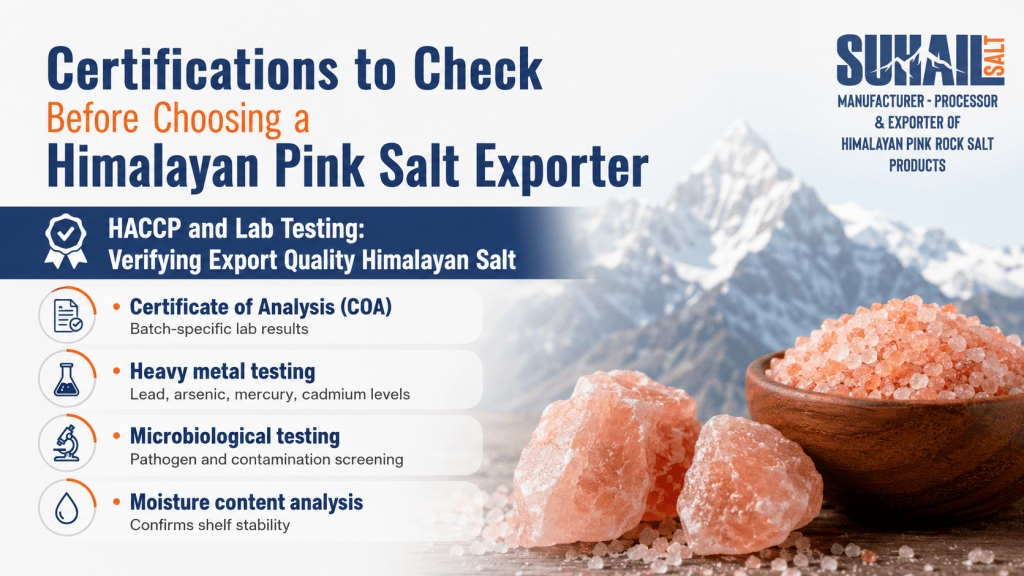
HACCP and Lab Testing: Verifying Export Quality Himalayan Salt
Beyond ISO, FDA, and Halal credentials, ask whether the supplier follows a HACCP (Hazard Analysis Critical Control Point) system. HACCP identifies points in the production process where contamination risks are highest and puts controls in place to manage them.
Lab testing is equally important for export quality Himalayan salt. Reputable exporters test each batch for heavy metals such as lead and arsenic, microbiological contamination, moisture content, and mineral composition. A Certificate of Analysis (COA) should accompany every shipment, listing test results against accepted limits.
- • Certificate of Analysis (COA) – Batch-specific lab results
- • Heavy metal testing – Lead, arsenic, mercury, cadmium levels
- • Microbiological testing – Pathogen and contamination screening
- • Moisture content analysis – Confirms shelf stability
Certificate of Origin and Export Documentation
A Certificate of Origin confirms that the salt was mined and processed in Pakistan, which can affect tariff rates and import eligibility depending on trade agreements between Pakistan and the destination country. Other documents to request include the packing list, commercial invoice, and bill of lading.
If you are importing into China, also confirm whether the supplier holds GACC registration, which is required for overseas food facilities exporting to the Chinese market under updated customs regulations.
Red Flags: Signs You Are Not Dealing With a Genuine Exporter
Some suppliers present themselves as manufacturers when they are actually trading companies sourcing from multiple unverified mines. This increases the risk of inconsistent quality and makes certification claims harder to verify, since the trading company may not control the actual production facility.
- • Certificates that cannot be verified through an official database
- • Reluctance to provide factory addresses or video tours of the production facility
- • No Certificate of Analysis offered for sample or bulk orders
- • Certification documents with mismatched company names or expired dates
- • Prices significantly below the market average without explanation
Working with a certified Himalayan pink salt exporter that owns or directly operates its processing facilities, such as Suhail Salt, removes most of this uncertainty. Direct manufacturers can provide live facility tours, batch-specific lab reports, and certification documents that match their registered company name.
|
Request a Free Sample from Suhail Salt Test our export quality Himalayan pink salt before committing to a bulk order. Contact us today to arrange a sample shipment with full documentation. |
How to Build a Supplier Verification Checklist
Before signing any agreement, compile a checklist covering each certification discussed above. This protects your business from compliance issues and gives you leverage during price negotiations, since suppliers who meet every requirement can justify premium pricing with documentation.
- • ISO 9001 and/or ISO 22000 certificate, verified through the issuing body
- • FDA registration number, current and matching shipping documents
- • Halal certificate listing the specific products you intend to order
- • HACCP documentation or food safety plan summary
- • Certificate of Analysis for the most recent production batch
- • Certificate of Origin and standard export paperwork
- • Factory audit report or video facility tour, if requested
Suhail Salt: A Certified Himalayan Pink Salt Exporter You Can Verify
Suhail Salt operates as a direct manufacturer and certified Himalayan pink salt exporter based near the Khewra Salt Mine region in Pakistan, supplying edible, bath, and decorative salt products to importers across North America, Europe, the Middle East, and Asia.
As an ISO certified salt exporter and FDA registered salt supplier, Suhail Salt provides full documentation with every order, including lab reports, Halal certificates, and Certificates of Origin. Buyers can verify every credential independently before placing an order.
For private label buyers, Suhail Salt also offers custom packaging, branding support, and flexible minimum order quantities suited to both established importers and growing businesses entering the Himalayan salt category.
|
Partner with a Verified Pakistani Salt Manufacturer Start your bulk import with Suhail Salt — ISO certified, FDA registered, and Halal compliant. Get in touch with our export team for pricing and lead times. |
For further reading on food import compliance, the U.S. Food and Drug Administration publishes guidance on food facility registration requirements under the Food Safety Modernization Act, which all FDA-registered salt suppliers must follow before shipping to US buyers.
Final Thoughts: Certifications Are Your Best Negotiating Tool
Choosing a certified Himalayan pink salt exporter is less about finding the lowest price and more about reducing risk across your entire supply chain. ISO, FDA, Halal, and HACCP certifications, combined with batch-level lab testing and proper export documentation, separate reliable manufacturers from unverified traders.
Before your next purchase order, run through the checklist in this guide and request copies of every certificate. Suppliers who provide complete, verifiable documentation without hesitation are the ones worth building a long-term partnership with.
People Also Ask: Certified Himalayan Pink Salt Exporter
Below are the most frequently searched questions related to certified Himalayan pink salt exporters, ordered from highest to lowest search demand, with concise answers optimized for featured snippets.
| Question | Answer |
What certifications should a Himalayan pink salt exporter have? |
A trustworthy certified Himalayan pink salt exporter should hold ISO 22000 or ISO 9001, HACCP, FDA registration, Halal certification, and a Certificate of Origin. These confirm food safety, quality control, and legal export compliance for international buyers. |
Is Himalayan pink salt FDA-approved? |
Himalayan pink salt itself is a natural mineral product, but a reputable FDA-registered salt supplier registers its facility with the FDA for food facility compliance, allowing legal import into the United States market. |
How do I verify a salt exporter’s ISO certification? |
Ask the exporter for their ISO certificate number and issuing body, then verify it directly on the certification body’s official online database or by contacting the certifying agency for confirmation. |
What does HACCP certification mean for salt exporters? |
HACCP certification means the exporter follows a documented Hazard Analysis Critical Control Point system, identifying and controlling contamination risks throughout salt mining, processing, and packaging. |
Is Pakistani Himalayan pink salt Halal certified? |
Yes, many export-quality Himalayan salt suppliers in Pakistan, including Suhail Salt, hold Halal certification confirming the product and processing meet Islamic dietary compliance standards required by Middle Eastern and Asian buyers. |
What is the difference between food-grade and industrial-grade Himalayan salt? |
Food-grade Himalayan salt undergoes stricter purity testing, heavy metal screening, and hygienic processing for human consumption, while industrial-grade salt is used for bath products, decor, or animal licks without the same food safety certifications. |
How can I find a certified Himalayan pink salt exporter in Pakistan? |
Search export directories, trade portals, and B2B platforms for suppliers listing ISO, HACCP, FDA, and Halal certifications, then request certificate copies and factory audit reports before placing a bulk order. |
What documents are required to import Himalayan salt into the USA? |
Importers need a Prior Notice filing with the FDA, a Certificate of Analysis, a Certificate of Origin, an FDA facility registration number from the supplier, and compliance with FSMA food safety regulations. |
Does Himalayan pink salt need lab testing before export? |
Yes, export-quality Himalayan salt should pass lab testing for heavy metals, microbiological safety, moisture content, and mineral composition, with results documented in a Certificate of Analysis. |
What is GACC registration for salt exporters to China? |
GACC registration is a mandatory certification from China’s General Administration of Customs that allows overseas food facilities, including salt processing units, to legally export food products into the Chinese market. |
How do I know if a salt supplier is genuine and not a middleman? |
Request factory audit reports, ask for live video tours of the processing unit, verify certification numbers independently, and check if the company owns or operates its own salt mines or processing facilities. |
What is the minimum order quantity for certified Himalayan salt export? |
Minimum order quantities vary by supplier and product type, typically ranging from one to twenty metric tons for bulk edible salt, though some certified exporters offer smaller trial orders for new buyers. |
Can small businesses import directly from a certified Himalayan salt exporter? |
Yes, many certified exporters work with small businesses by offering flexible minimum order quantities, private label packaging, and sample shipments before committing to larger bulk orders. |
What packaging standards apply to exported Himalayan pink salt? |
Export packaging must meet destination country labeling laws, including nutritional information, country of origin, batch numbers, and food-grade packaging materials that prevent moisture contamination during shipping. |
Why is Pakistan known for the best Himalayan pink salt? |
Pakistan’s Khewra Salt Mine, one of the world’s oldest and largest salt deposits, produces naturally mineral-rich pink salt prized globally for its purity, color variation, and certified export quality standards. |